
Why Your Hot Water Runs Out Faster When the Weather Turns Cold
Your shower feels shorter in November than it did in July, and your water heater is not imagining things. As fall settles over north Georgia, the ground cools down and the water entering your home arrives significantly colder than it did during the summer months. Your water heater still has the same burner or the same heating elements, but now it has to close a much wider temperature gap to deliver the same comfortable shower. A tank that easily handled three back to back morning showers in August can start running lukewarm halfway through the second one by the time December arrives. Most homeowners assume the unit is finally failing, when in reality the answer is usually a combination of basic physics, higher winter demand, and maintenance that has been postponed for a few too many years. Some of what you are feeling is completely normal seasonal behavior, and some of it points to a real mechanical problem inside the tank that will only get worse. Knowing the difference protects your budget and keeps you from replacing a water heater that still has good years left in it.
What Makes Hot Water Run Out Faster in Cold Weather
Cold weather changes the math inside every water heater in Cherokee County, and that math is not subtle. Your unit is not producing less heat than it did in June; it is being asked to raise incoming water through a far larger temperature rise using the same amount of fuel or the same wattage. That single change affects how much usable hot water you get out of the tank, how quickly the tank reheats once it has been drained, and how long you can run a shower before the temperature starts sliding. Household demand climbs during the same months, because almost nobody takes a quick shower when the house is sitting at 66 degrees and the tile floor is freezing. Three separate factors stack on top of one another from roughly October through March, and each one alone would be manageable while all three together are very noticeable. Understanding how they interact tells you quickly if you are dealing with a predictable seasonal pattern or an appliance that needs professional attention.
Colder Incoming Water Makes Hot Water Run Out Faster
Groundwater temperature is the starting point for everything your water heater does, and it swings by a surprising margin across the year. During a Georgia summer, water arriving at your home from the municipal main or from a private well commonly sits somewhere in the low seventies, because the soil and the distribution piping have been soaking up heat for months. By late winter, that same supply water can drop into the low fifties or even the high forties after a stretch of hard freezes. If your thermostat is set to the standard 120 degrees, summer requires roughly a 50 degree rise while winter can require 70 degrees or more of rise for every single gallon. That is about 40 percent more energy needed per gallon, delivered by a burner or an element that has not changed at all. Nothing inside the tank has broken, yet the workload has increased dramatically. This is the single biggest reason that hot water complaints spike as soon as the weather turns.
The effect gets amplified at the fixture, which is where you actually notice the problem. You do not shower in 120 degree water; you shower in something closer to 105 degrees, blended at the valve with cold water from the same supply line. When that cold water is 70 degrees, you only need about seven parts hot to three parts cold to hit a comfortable temperature. When the cold water drops to 50 degrees, the valve has to pull closer to eight parts hot for every two parts cold to reach the exact same 105 degrees on your skin. That means you are draining stored hot water noticeably faster during every minute of every shower, even though your habits have not changed. Over a ten minute shower the difference adds up to several extra gallons pulled from the tank. Multiply that across a family of four and the tank simply cannot keep pace the way it did in July.
Tankless units feel this shift even more directly, because they are rated by flow rate at a specific temperature rise rather than by storage volume. A large residential tankless heater rated near 199,000 BTU might comfortably deliver eight or nine gallons per minute when it only has to raise water 45 degrees during the summer. Push that same unit to a 70 degree rise in January and its honest output drops to somewhere around five gallons per minute. Nothing has failed and no part has worn out; the unit is simply throttling flow to protect the outlet temperature you asked for. Homeowners who could run a shower and the dishwasher at the same time in August suddenly find that the shower goes lukewarm when someone starts the laundry. Proper sizing accounts for winter conditions rather than summer conditions, which is exactly why undersized units feel fine for half the year and disappointing for the other half. If your tankless system struggles every winter, click here for our tankless water heater services and we will evaluate the sizing against real winter numbers.
Slower Recovery Time Makes Hot Water Run Out Faster
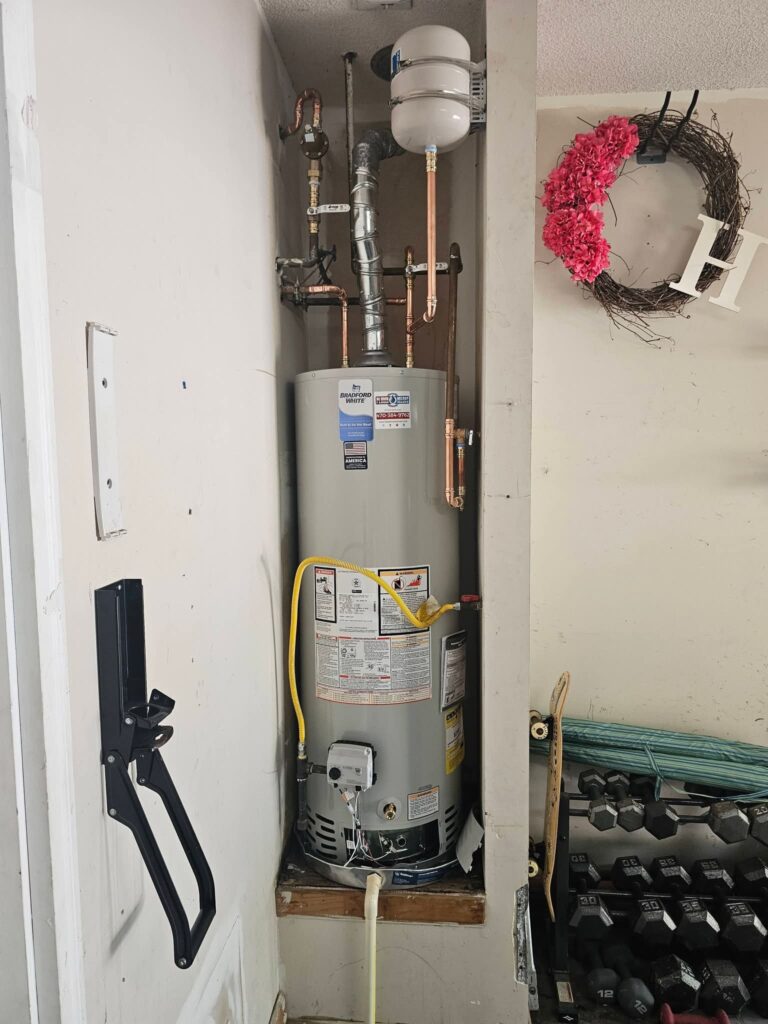
Recovery rate describes how many gallons your water heater can heat in an hour, and it falls in direct proportion to the temperature rise required. A typical 40 gallon gas water heater with a 40,000 BTU burner can reheat roughly 75 gallons per hour when the rise is only 50 degrees. Push the same burner to a 70 degree rise and that number falls to something near 55 gallons per hour. Electric models feel the pinch much harder, since a standard 4,500 watt element produces far less heat per hour than a gas burner does. That electric tank might recover close to 37 gallons per hour in summer conditions and barely 26 gallons per hour once winter arrives. The tank capacity printed on the label never changes, but the practical capacity of the whole system absolutely does.
Recovery matters most during the busy stretches of your morning, because household hot water use is rarely spread evenly across the day. Everyone showers inside the same 90 minute window, and the tank does not have time to catch up in between. In warm months, the burner can partially replenish the top of the tank while the second person is still getting ready. During cold months, that same burner falls behind after the first shower and never regains ground until the house empties out. This is why the last person in line gets a cold surprise even though the first two people had no complaints at all. Staggering showers by twenty or thirty minutes is a free fix that solves the problem in a lot of homes across Woodstock, Canton, and Holly Springs.
Recovery also degrades when the equipment is not operating at its rated efficiency, and that degradation hides behind the seasonal change. A gas burner with a dirty orifice, a partially blocked flue, or a soot covered heat exchanger transfers less heat into the water than the label promises. An electric tank running on one functioning element instead of two loses a huge portion of its recovery capacity. In summer those weaknesses go unnoticed because the required temperature rise is small enough that even a compromised unit keeps up. Winter removes that margin completely and exposes every deficiency at once. A professional combustion check, element test, and thermostat calibration restores much of the lost performance without any equipment replacement.
Higher Winter Demand Makes Hot Water Run Out Faster
Behavior changes when the temperature drops, and household hot water demand climbs right along with it. Showers get longer because standing in warm water feels good when the air is cold, and people linger under the spray instead of finishing efficiently. Hand washing at the sink shifts from cold to hot throughout the day. Laundry loads move to warm or hot settings, especially with heavy blankets, coats, and flannel bedding entering the rotation. Holiday cooking and entertaining add dish loads that never happen in the middle of summer. Each individual change is small, but together they can raise total daily hot water consumption by twenty percent or more.
Guests compound the problem in a way that catches families off guard every year. A house sized for four people suddenly hosts seven or eight over Thanksgiving and Christmas, and the water heater has no idea that the schedule changed. Extra showers, extra laundry, and extra dishwasher cycles hit a tank that is already working with a reduced effective capacity. The result is a house full of relatives discovering cold water at the worst possible time. Planning around the tank helps a great deal, and running the dishwasher overnight instead of right after dinner frees up capacity for the morning rush. Homes that host regularly are often better served by a larger tank or by a properly sized tankless system.
Cold air around the equipment itself quietly steals capacity as well, and this catches a lot of Georgia homeowners by surprise. Most water heaters in this area sit in an unconditioned garage, a crawl space, or an exterior closet where winter temperatures can dip into the thirties. Standby heat loss through the tank walls and through the first several feet of piping increases sharply once the surrounding air gets that cold. The burner or element fires more often just to hold temperature, which means more fuel is spent on maintaining the tank rather than on serving your family. An insulating blanket rated for your specific model, along with foam insulation on the hot outlet and the first six feet of exposed pipe, recovers a meaningful chunk of that loss. These are inexpensive materials that pay for themselves over a single winter.
Water Heater Problems That Make Hot Water Run Out Faster
Seasonal physics explains most of the change, but it does not explain everything. When hot water disappears in five minutes instead of fifteen, or when the temperature drops off a cliff instead of fading gradually, something inside the system has genuinely failed. Winter is simply the season that removes your safety margin and makes existing defects impossible to ignore any longer. A water heater with sediment, a broken internal component, or a plumbing side cross connection may have been quietly underperforming for a year or more. The cold months push it past the point where you can live with it. These are the failures we find most often on service calls between October and March.
Sediment Buildup and Hot Water That Runs Out Faster
Sediment is the most common capacity killer we encounter in tank style water heaters throughout north Georgia. Minerals suspended in the water supply precipitate out as the water heats, and they settle into a hardening layer across the bottom of the tank. In a gas unit, that layer sits directly between the burner flame and the water, acting as insulation and forcing the burner to run far longer to move the same amount of heat. In an electric unit, sediment buries the lower heating element and can eventually cause it to burn out entirely. Two or three inches of accumulated sediment in a 50 gallon tank effectively steals gallons of storage volume that you paid for. You end up with a 40 gallon water heater wearing a 50 gallon label.
The symptoms follow a recognizable pattern once you know what to listen for. Popping, rumbling, or crackling noises during a heating cycle mean water is flashing to steam underneath the sediment layer. Recovery slows down noticeably, energy bills creep upward month over month, and hot water runs out sooner than it used to at every fixture. Rust colored or cloudy water at the tap can appear as the deposits break loose and travel through the plumbing. Left alone, sediment overheats the steel at the bottom of the tank, damages the glass lining, and dramatically shortens the life of the entire unit. What starts as an inconvenience turns into a tank replacement and sometimes a flooded garage.
Annual flushing is the fix, and it is straightforward preventive maintenance rather than a repair. A technician connects a hose to the drain valve, drains the tank fully, and uses controlled bursts of supply pressure to lift the settled material off the bottom before flushing it out. Heavily neglected tanks sometimes need the drain valve replaced, because the original plastic valve clogs solid or refuses to reseal after years of untouched buildup. Homes with hard water benefit from flushing on a strict twelve month schedule, and a whole home filtration or softening system reduces the rate of accumulation considerably. Scheduling this in early fall means your tank enters the cold season with its full rated capacity available. Ready to get the sediment out before winter? Click here for our water heater repair and maintenance services.

Failed Parts That Make Hot Water Run Out Faster
A broken dip tube produces the most dramatic version of this complaint, and it is frequently misdiagnosed as a dead water heater. The dip tube is a long plastic pipe that carries incoming cold water down to the bottom of the tank, keeping it separated from the heated water waiting at the top. When that tube cracks, splits, or breaks off near the fitting, cold water dumps straight into the upper portion of the tank and mixes with your hot supply. The result is a shower that starts warm and turns cold in three or four minutes, even though the burner is firing normally and the thermostat reads correctly. Homeowners often replace an entire water heater over a part that costs very little. A technician can confirm the failure quickly by comparing inlet and outlet temperatures under load.
Electric water heaters have their own signature failure, and it shows up as a very consistent amount of hot water followed by nothing. These units use two elements, one high in the tank and one near the bottom, controlled by separate thermostats. When the lower element fails or its thermostat stops calling for heat, only the top third of the tank ever gets hot. You get roughly fifteen gallons of usable hot water instead of fifty, which is enough for exactly one short shower. The tank never trips a breaker and never leaks, so nothing looks obviously wrong from the outside. Element testing takes a few minutes with a multimeter and the replacement parts are inexpensive compared to a new water heater.
Gas units fail in ways that reduce output more gradually, which makes them easier to ignore until winter. A weak thermocouple or flame sensor causes intermittent burner shutdowns, a partially clogged burner assembly reduces heat input, and a drifting gas control valve holds the tank below its actual setpoint. Carbon buildup on the burner ports produces a lazy yellow flame instead of a crisp blue one, wasting fuel and creating combustion byproducts you do not want inside your home. Blocked flue passages or a compromised vent connector are safety concerns well beyond the question of shower length. Any gas appliance showing soot, scorching, or a persistent pilot problem deserves professional inspection immediately. These are not repairs to attempt with an online video and a wrench.
Heat Loss and Plumbing Issues That Make Hot Water Run Out Faster
Sometimes the water heater is performing perfectly and the plumbing between the tank and the fixture is the actual culprit. Long uninsulated runs through a cold crawl space or attic bleed heat out of the water on its way to the shower, so you open the valve wider and drain the tank faster to compensate. Homes with the water heater on one end and the master bathroom on the other feel this most acutely. Insulating accessible hot water lines is inexpensive and delivers noticeable improvement in both wait time and delivered temperature. A recirculation system with a proper timer or demand control solves it more completely in larger homes. Recirculation lines that run continuously without control, on the other hand, waste enormous amounts of energy and keep the burner cycling all night.
Cross connections quietly destroy hot water capacity and almost never get diagnosed by homeowners. A failed cartridge inside a single lever shower or tub valve can allow cold water to migrate backward into the hot line while the fixture is closed. A stuck check valve on a recirculation loop does the same thing, as does a defective thermostatic mixing valve at the tank outlet. The effect is a slow, constant dilution of the hot water sitting in your tank and in your supply lines. You will notice lukewarm water at fixtures that used to be fine, along with a burner that seems to run more often than the household demand justifies. Isolating the fixtures one at a time identifies the offender in short order.
Undetected leaks belong on this list as well, and cold weather increases the odds of finding one. A slab leak on the hot side, a dripping pressure relief valve, or a pinhole in aging galvanized or copper piping continuously drains heated water you paid to produce. Warm spots on the floor, a water heater that runs with no fixtures open, and a rising water bill are all reliable warning signs. Freezing conditions add the risk of split pipes in exterior walls and unprotected crawl spaces, which turns a hot water complaint into an emergency in a matter of hours. Professional leak detection locates the problem without demolishing walls or floors to go hunting. If you suspect a hidden leak on your hot water line, click here for our leak detection services before the damage spreads.
Why You Need a Water Heater Checkup Before Winter Arrives
Fall is the ideal window to service a water heater, because it lands after the summer rush and before the first hard freeze exposes every weakness in the system. A thorough checkup identifies sediment, failing components, venting problems, and safety issues while there is still time to address them calmly. Repairs made in October cost less and cause far less disruption than emergency calls made on a cold January morning with no hot water in the house. A properly serviced tank also runs more efficiently, which matters when the required temperature rise climbs and the burner works harder all season. Most importantly, a professional inspection catches the corrosion and pressure problems that lead to tank ruptures and flooded garages. Spending an hour now is a much better trade than replacing drywall and flooring later.
What a Water Heater Checkup Before Winter Includes
A complete inspection starts with a full tank flush to remove the sediment layer that has accumulated since the last service. The technician then tests the temperature and pressure relief valve, verifies the thermostat setting against actual delivered temperature, and confirms that the setpoint sits at a safe and efficient 120 degrees. On gas models, the burner assembly, flame pattern, thermocouple, gas control valve, and venting all get examined for proper operation and safe combustion. On electric models, both elements and both thermostats get tested under load to confirm the full tank is actually heating. Expansion tanks, shutoff valves, and supply connections are checked for corrosion, pressure, and leaks.
The anode rod inspection is the step that most homeowners have never heard of and the one that extends equipment life the most. This sacrificial magnesium or aluminum rod corrodes on purpose so the steel tank does not, and it wears out somewhere between three and five years in typical Georgia water conditions. Once it is gone, the tank lining begins to fail and the countdown to replacement starts in earnest. Replacing a depleted rod is far less expensive than replacing a water heater. Many tanks that fail at eight years would have reached fifteen with one rod change along the way.
The visit ends with an honest report on the condition and remaining life of the equipment. You should know the age of your unit, the state of the tank, the condition of the connections, and what to expect over the next several years. That information lets you plan a replacement on your own schedule instead of reacting to a failure at the worst possible time. Want a complete evaluation before the cold sets in? Click here for our water heater inspection service.
When to Repair or Replace Before Winter
Repair is usually the right call when the tank itself is sound and the problem is a specific component. Dip tubes, elements, thermostats, thermocouples, gas control valves, and drain valves are all replaceable at a fraction of the cost of a new system. A well maintained tank under eight years old with a single failed part is worth fixing every time. Sediment problems fall into the same category, since a flush restores lost capacity without any new equipment. Repairing what can be repaired is the position we take on every call.
Replacement becomes the better investment once the tank is past ten or twelve years old, especially when it is paired with visible corrosion or a history of repeated repairs. Rusty water, moisture around the base, or weeping at the seams means the internal lining has failed and no repair will bring it back. At that point, continuing to patch the unit is simply paying to delay an outcome that is already decided. Replacing before a failure lets you choose the equipment and the timing rather than accepting whatever is available during an emergency. It also protects you from the water damage that a ruptured tank creates in a finished space.
Capacity is worth revisiting during any replacement conversation, because household needs change over the years. A family that has grown, added a bathroom, or installed a soaking tub may have outgrown the original tank without ever realizing it. Upgrading tank size, moving to a high recovery model, or switching to a properly sized tankless system eliminates the winter shortage for good. Financing is available through Wisetack, which keeps a planned upgrade manageable instead of forcing a compromise. Ready to talk about the right system for your home? Click here for our water heater installation services.
Why Choose Plumb Medic for Your Water Heater Before Winter
Plumb Medic serves Woodstock, Canton, Marietta, Kennesaw, Acworth, Roswell, Alpharetta, Holly Springs, Ball Ground, Cumming, and the surrounding north Georgia communities with fully licensed and experienced technicians. Every visit starts with a real diagnosis rather than a guess, because replacing a water heater that needs a twenty dollar part serves nobody. Our team is TracPipe and Navien certified, which matters a great deal on gas connections and tankless systems where the work has to be exactly right. We waive the diagnostic fee when we handle the repair, so you are not paying twice to solve one problem. Business Rate named us Best of Woodstock Plumber in 2025, and we work hard to keep earning that.
We offer 24/7 emergency plumbing service, because water heaters do not fail politely during business hours. Military and senior discounts are available on our services, and financing through Wisetack makes larger repairs and replacements far easier to manage. We also donate two percent of every service call to Children’s Healthcare of Atlanta, supporting families right here in our own community. Our technicians show up on time, explain what they find in plain language, and give you options rather than pressure. You will always know what the work costs before it begins.
Do not wait until the first hard freeze to find out that your water heater cannot keep up. A checkup in the fall costs very little, takes about an hour, and often adds years to the life of equipment you already own. Our team will flush the tank, test every component, correct the setpoint, and tell you honestly where things stand. Call Plumb Medic at (470) 384-9762 or email office@theplumbmedic.com to schedule your water heater service at 225 Creekstone Ridge Suite 19, Woodstock, GA 30188. Get it handled now and enjoy a full hot shower all winter long.